Connect this guide with the rest of your visit in the Tallinn trip planner. Read how the research is made and what its sources establish.
At a glance
Start here
- Rotermann joins protected industrial buildings with conspicuously new architecture.
- Telliskivi's reuse grew incrementally across a factory compound rather than one monument.
- Noblessner's shipyard history helps explain the scale and waterfront logic of Kai and PROTO.
- The Seaplane Harbour shows how a collection can make an extraordinary engineering shell intelligible.
01
Adaptive reuse is a method, not a style
Rotermann, Telliskivi, and Noblessner had different industries, building types, ownership paths, and relationships to the city. Their present brick, concrete, glass, signs, and public spaces can look like one design trend from a distance, but the historical questions differ. Grain handling does not require the same architecture as shipbuilding or aircraft storage.
Begin with function. What arrived, what was produced or stored, how did large objects move, and why was the water or railway nearby? Then ask what the conversion preserved. A successful visit does not require deciding whether every project is beautiful; it requires seeing where old work remains readable and where new use has overwritten it.
Sources: Estonian Museum of Architecture; Telliskivi Creative City; Noblessner; Estonian Maritime Museum02
At Rotermann, compare protected fabric with new insertions
The Estonian Museum of Architecture describes Rotermann as a quarter where protected nineteenth-century industrial buildings meet contemporary architecture. Former mill, grain, and flour buildings now hold shops, restaurants, offices, and apartments. The museum itself occupies the former salt storage building, giving the district an institution devoted to explaining built form.
The contrast is deliberate enough to study from public space. Look for additions that remain visibly new instead of imitating old masonry, and trace how passages have been cut through former production blocks. Reuse here is not a return to an imagined industrial past; it is a dense mixed-use district that keeps selected shells and materials in active tension with recent design.
Sources: Estonian Museum of Architecture03
At Telliskivi, read the compound incrementally
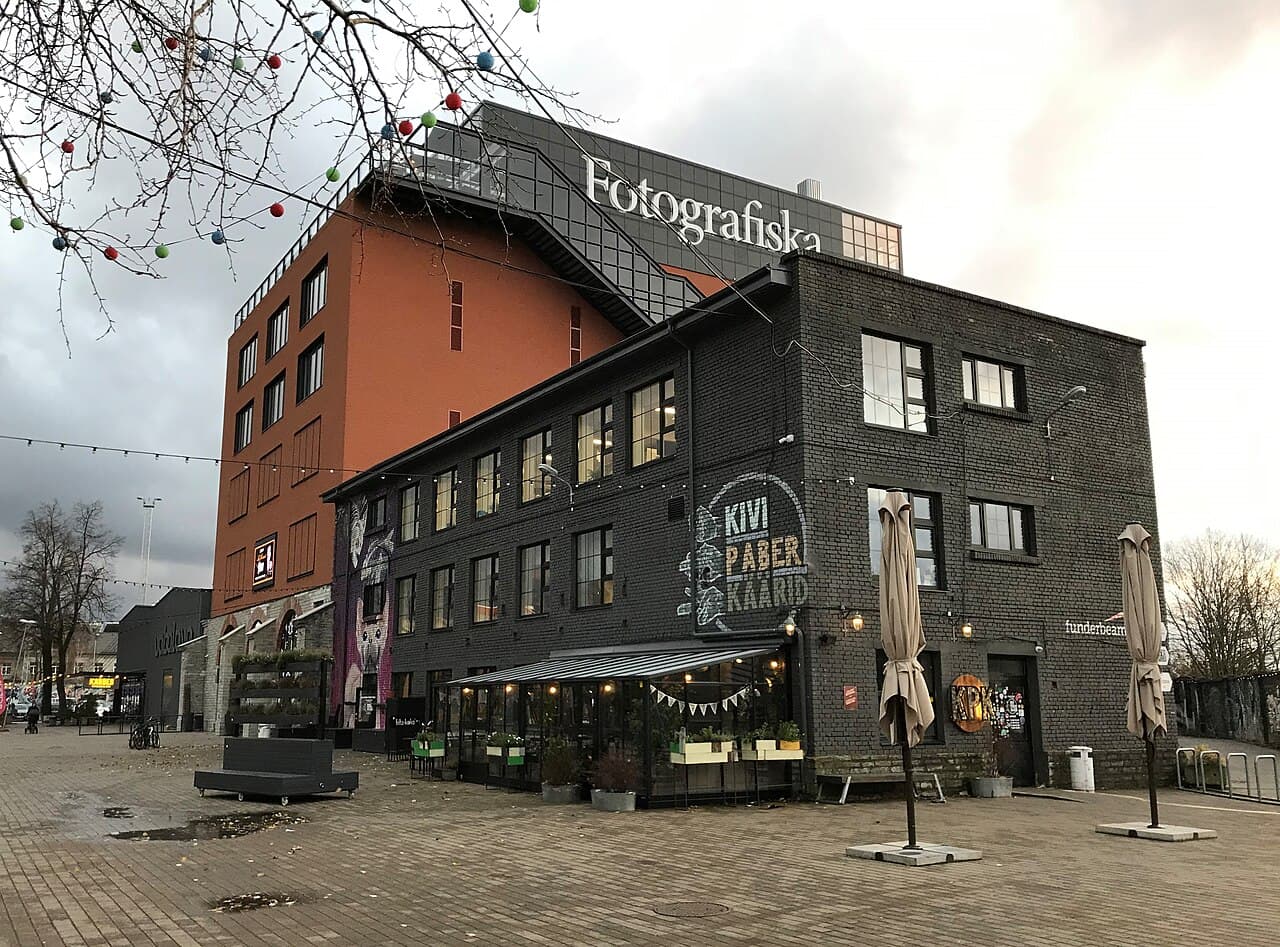
Telliskivi Creative City records the beginning of its redevelopment in 2007 and the arrival of its first tenant in 2009. Its own account emphasizes gradual repair and the adaptation of a former factory complex for varied cultural and commercial occupants. The result is a collection of buildings and yards rather than one restored architectural object.
That incremental character is visible in uneven finishes, service spaces, murals, additions, and different tenant footprints. Ask how a large compound can admit small uses without erasing circulation inherited from industry. Because the operator's current counts and listings can change, they are less useful here than the durable chronology and the physical evidence of staged adaptation.
Sources: Telliskivi Creative City04
At Noblessner, keep shipbuilding in the frame
Noblessner began as a submarine shipyard in 1912. Its official history records twelve submarines built from 1913 to 1917 and continued ship construction and repair until August 2018. The size of halls, yards, and waterside connections follows those tasks; later public uses occupy an industrial geography made for vessels and heavy production.
The redevelopment is ongoing, so a polished waterfront should not be mistaken for the whole site or a final state. Look inland as well as toward the water. Distances between structures, surviving limestone and concrete, and oversized doors can explain production better than a new commercial directory can.
Sources: Noblessner05
Kai turns a vessel workshop into an art centre
Kai Art Center occupies Noblessner's former vessel systems department, a heritage-protected building where coppersmiths and joiners once worked. Its institutional account credits the restoration to KAOS Architects with HGA and dates the art centre's opening to 2019. Limestone and concrete, a rounded roof, and roof lanterns remain central to the converted structure.
The building is useful even when a current exhibition is not the subject. Compare the broad workshop volume with the more controlled spaces required for art, audiences, and services. Kai's page carried a temporary-closure notice when researched, so this article uses its architectural history only and makes no promise that the interior is available on a particular day.
Sources: Kai Art Center06
PROTO uses play to reinterpret industrial ambition
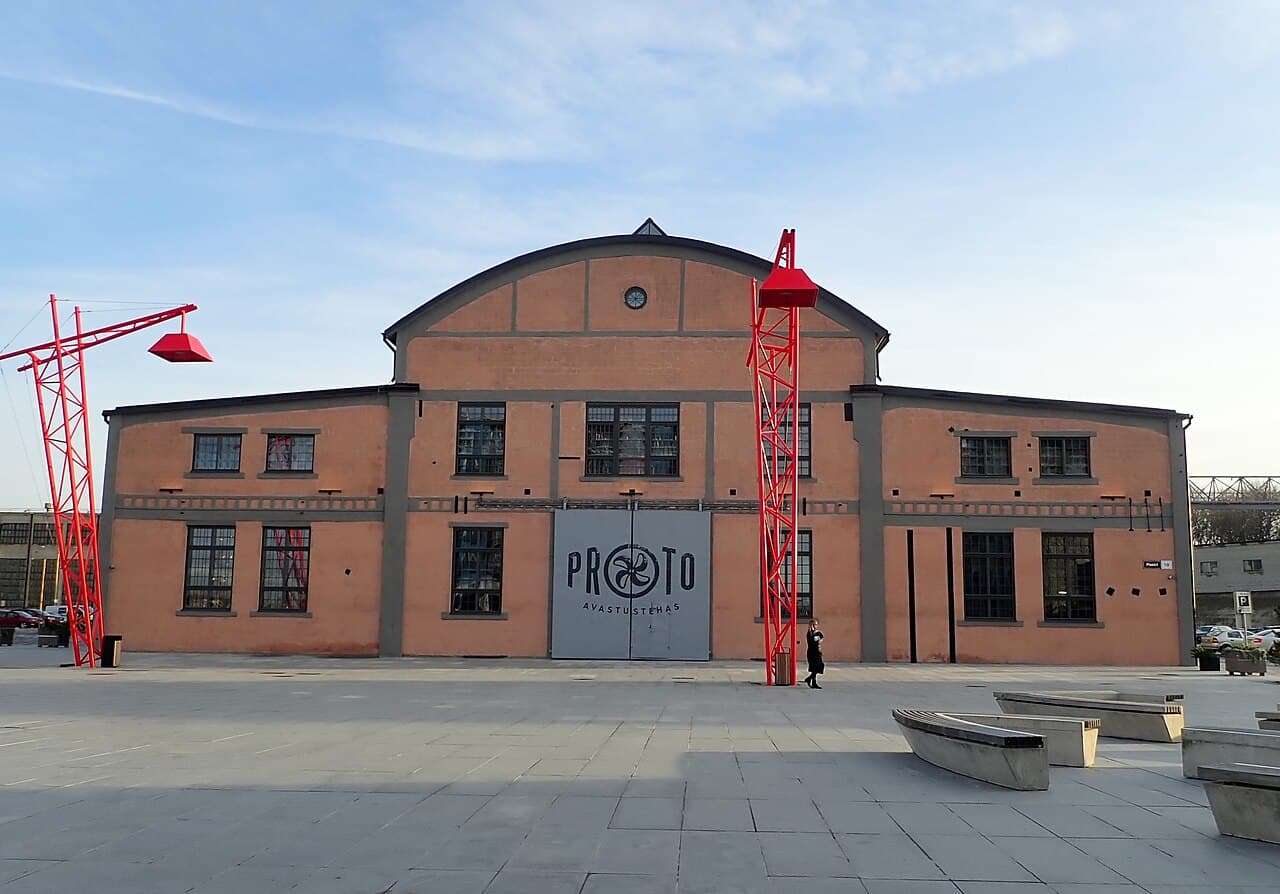
PROTO Invention Factory also occupies the Noblessner shipyard environment. Its visitor concept places nineteenth-century inventions, virtual reality, and hands-on mechanisms inside a historic industrial building. Instead of reconstructing one workshop process, it uses the setting to connect technological imagination with experimentation and movement.
That is a different preservation strategy from Kai's gallery conversion. The industrial shell acts as an atmosphere for invention rather than an exhibition solely about the shipyard. Judge the relationship honestly: notice where the building supplies scale and material character, then distinguish that evidence from the interactive narrative installed inside it.
Sources: PROTO Invention Factory; Noblessner07
The Seaplane Harbour joins shell and collection
The Estonian Maritime Museum opened its Seaplane Harbour branch in 2012 inside the historic hangars. The submarine Lembit, a Short 184 seaplane, the Maasilinn wreck, boats, and mines exploit the enormous interior volume. Here the reused building and the collection reinforce each other through a shared maritime and engineering context.
Move between viewing levels and observe how the hangar changes the perceived size of each object. The display does not recreate the original operation of the building, yet it makes structural span, aircraft scale, and harbour history mutually legible. Among Tallinn's conversions, it is the clearest example of new public use depending on the old shell's exceptional dimensions.
Sources: Estonian Maritime MuseumUseful answers
Reader questions
Where is Tallinn's clearest old-and-new architectural contrast?
Rotermann offers the most concentrated comparison because protected nineteenth-century industrial buildings stand beside explicitly contemporary additions. The former salt store, mills, grain buildings, and newer mixed uses let visitors compare material, scale, and intervention without assuming that preservation requires visual imitation.
Sources: Estonian Museum of ArchitectureAre Telliskivi and Noblessner the same kind of reuse project?
No. Telliskivi's operator describes an incremental redevelopment of a former factory compound beginning in 2007. Noblessner occupies a waterfront shipyard founded in 1912, with vessel production and repairs continuing much later. Their building scales, circulation, industrial histories, and present development paths differ.
Sources: Telliskivi Creative City; NoblessnerDoes Kai's current availability affect its architectural significance?
No, but it affects whether you can visit inside. Kai's own page documents the former vessel-workshop function, protected structure, design team, and 2019 conversion. It also carried a temporary-closure notice at research time, so check the institution directly and do not infer interior access from this historical discussion.
Sources: Kai Art CenterWhich conversion best connects its building with its collection?
The Seaplane Harbour makes the closest thematic connection. Historic hangars hold aircraft, a submarine, boats, a shipwreck, mines, and maritime simulations. The structure's scale helps visitors understand the objects, while the objects give the unusual engineering shell a continuing public purpose.
Sources: Estonian Maritime MuseumRead the evidence
Sources and further reading
These sources support the relevant sections above. Plans and comparisons are editorial suggestions. Check operators for current arrangements.
- City Tours ↗Estonian Museum of Architecture · Research date 14 September 2026
Rotermann's protected industrial buildings, contemporary additions, former production uses, and salt-store museum.
- The Story of Telliskivi Creative City ↗Telliskivi Creative City · Research date 14 September 2026
The former factory compound, redevelopment beginning in 2007, first tenant in 2009, and incremental approach.
- About Noblessner ↗Noblessner · Research date 14 September 2026
The 1912 shipyard origin, submarine production, later vessel repair, and evolving redevelopment setting.
- About Kai Art Center ↗Kai Art Center · Research date 14 September 2026
The former vessel systems workshop, restoration team, 2019 opening, structural details, and current closure notice.
- PROTO Invention Factory ↗PROTO Invention Factory · Research date 14 September 2026
The historic Noblessner setting and the virtual-reality and hands-on invention concept.
- Introduction to the Museum ↗Estonian Maritime Museum · Research date 14 September 2026
The 2012 museum opening in historic hangars and the large maritime objects displayed inside.